- Lehrende(r): Rabia Akin
- Lehrende(r): Wiebke Böggering
- Lehrende(r): Franziska Martinsen
Kursbereich: Politikwissenschaft
Grundsätzlich steht im Kolloquium die Vorbereitung und Diskussion des
bevorstehenden Studienabschlusses im Vordergrund – und damit also die
Bachelor- oder Master-Thesis. Ein Kernbestandteil der Veranstaltung ist
demnach die Vorstellung eines Untersuchungsgegenstandes und
die Skizzierung eines Forschungsrahmens. Idealer Weise stehen am Ende
des Semesters dann Thema, Fragestellung, Arbeitshypothesen und ein
Zeitplan fest. Selbstverständlich kann im Rahmen des Kolloquiums auch
aus bereits laufenden Arbeiten (oder Arbeitsvorbereitungen) berichtet
werden.
Das Seminar ist Teil des bildungswissenschaftlichen Studiums der Lehramtsstudierenden im Bachelor und bereitet auf die erste Praxisphase in der Schule, das Eignungs- und Orientierungspraktikum, vor.
Das Seminar ist Teil des bildungswissenschaftlichen Studiums der Lehramtsstudierenden im Bachelor und bereitet auf die erste Praxisphase in der Schule, das Eignungs- und Orientierungspraktikum, vor.
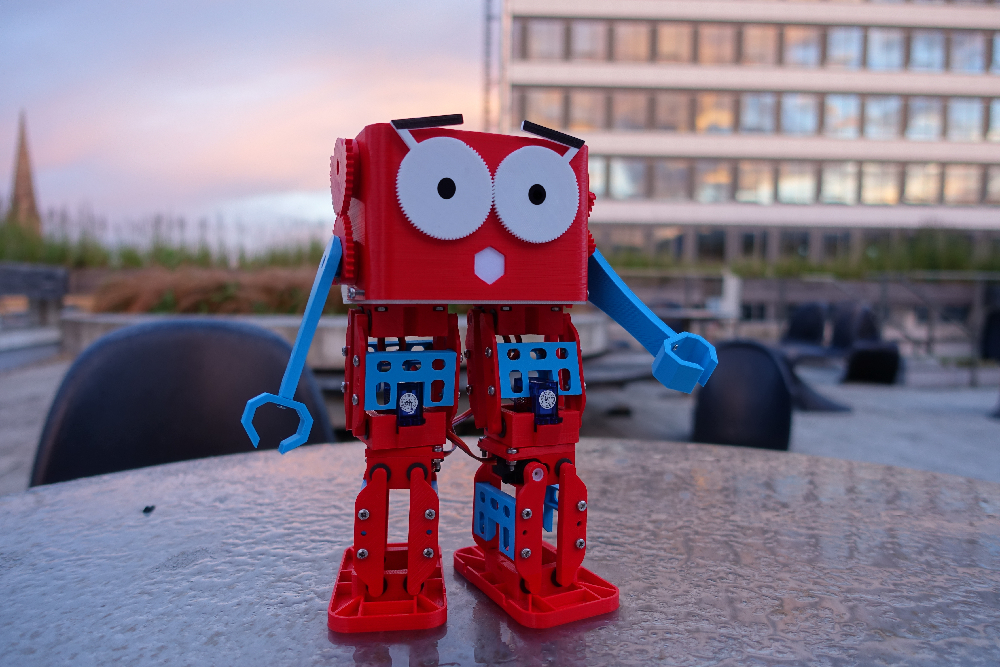
The goal of the bachelor project is to introduce students to mobile robotics and the challenges associated with it. In this project, a mobile robot serves as the base on which the implementations are tested. Depending on their interest, students can either use an existing small robotic arm or build a small arm/gripper themselves, learning the basics of CAD and/or PCB design. The logic of the robot is controlled using the OpenSource library OpenCV via a camera and, depending on interest, the use of neural networks can also be considered.
For the project we expect a high degree of motivation from the students to learn new skills and languages. Ideally, prior knowledge of the languages C++ or Python exists, but is not a requirement.
The goal of this bachelor project is to familiarize students with
basic problems related to the surveillance of parking lots. Within the
project, participants will be implementing different
surveillance-related tasks, such as estimating parking space utilization or detecting illegally parked cars.
Thereby, students will get in touch with the OpenCV library that implements a broad range of computer vision algorithms, most notably neural networks, feature-matching or image manipulation.
Participants in this course are expected to be highly motivated and must have a solid understanding of one programming language, knowledge of programming in Java or C++ are of advantage
Are you ready to put your programming skills to the ultimate test in a high-stakes challenge? Enroll to our Bachelor Project course, where you’ll dive into the world of robotics and autonomous navigation in a Maze Runner-style competition. Your mission: to program a robot capable of navigating a complex labyrinth and finding the exit faster than any other team.
In this course, you’ll focus on the intricacies of robot programming, honing your skills in algorithm development, sensor integration, and real-time decision-making. Your task is to write the code that will enable your robot to think and act independently, overcoming obstacles and optimizing its path to escape the maze.
Working in teams, you’ll face the thrill of competition as you strive to refine your robot's navigation abilities, pushing the limits of your programming expertise. This hands-on project not only deepens your understanding of robotics software but also sharpens your problem-solving, critical thinking, and teamwork skills—key assets in the tech world.
If you’re passionate about coding, love a challenge, and are eager to prove your skills in a competitive setting, this Bachelor Project is the course for you. Join us and see if your programming can lead your team to victory!
The goal of this Bachelor Project is to introduce students to the challenges of mobile robotics. You’ll work with a mobile robot as the platform for your implementations, learning the fundamentals of ROS (Robot Operating System): from navigating with a robot to gathering data from various sensors and using it to make decisions to escape the maze.
Participants in this course are expected to be highly motivated and must have a solid understanding of one programming language, knowledge of programming in Python or C++ are of advantage. The kick-off meeting will take place on 08.10 10:00 in room SA-215, further registration is not possible. Participation in the kickoff meeting is mandatory.
This course may be held in German and English depending on the participants. The project is suitable for students at the bachelor level. If you are not sure whether you fulfill the requirements or if you have any questions, please send an email to carlos.medina-sanchez@uni-due.de

The goal of this bachelor project is to familiarize students with basic problems related to the surveillance of traffic-scenes. Within the project, participants will be implementing different surveillance-related tasks, such as speeding detection on highways or parking lot monitoring.
Thereby, students will get in touch with the OpenCV library that implements a broad range of computer vision algorithms, most notably neural networks, feature-matching or image manipulation.
The goal of this bachelor project is to familiarize students with basic problems related to the surveillance of traffic-scenes. Within the project, participants will be implementing different surveillance-related tasks, such as speeding detection on highways or parking lot monitoring.
Thereby, students will get in touch with the OpenCV library that implements a broad range of computer vision algorithms, most notably neural networks, feature-matching or image manipulation.
(Lehrstuhl Intelligente Systeme http://www.is.uni-due.de/ )
Sprache: Englisch/Deutsch
Im Seminar werden ausgewählte Themen der Funktionalanalysis behandelt.
Eine Vorbesprechung findet am 07.09.21 ab 11 Uhr voraussichtlich im Raum WSC-N-U-4.04 statt (ggf. in einem benachbarten Raum).
Informationen zum Kursablauf: